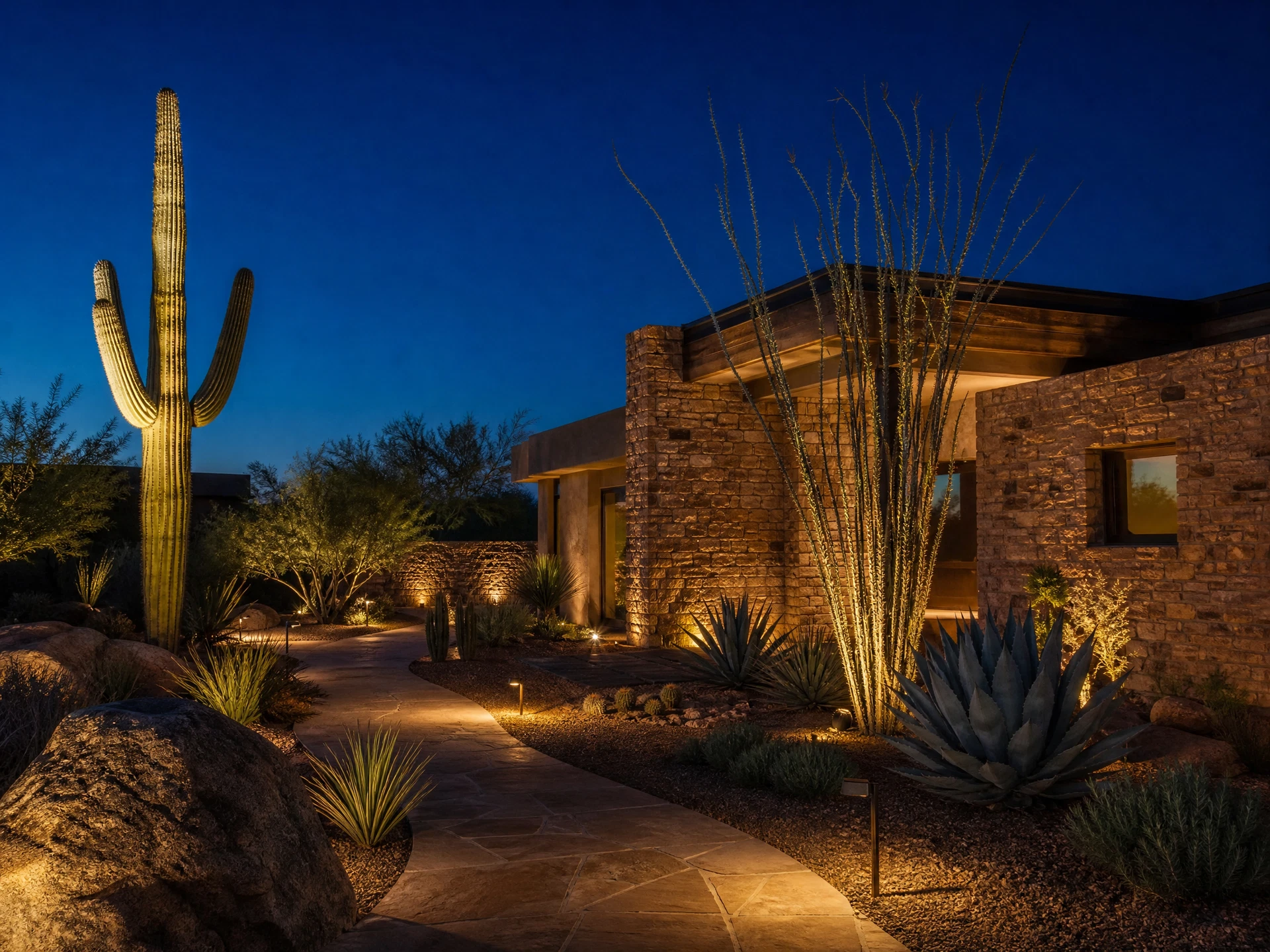
Landscape Lighting
Low-voltage versus solar, dim fixtures, transformer sizing, controls, cable, and nighttime operation.
4 focused questions in this topic.
Each article has a direct answer, safe homeowner observations, professional thresholds, visible sources, and related reading.
Is low-voltage landscape lighting better than solar lighting in Arizona?
Low-voltage landscape lighting offers superior brightness, reliability, and durability in Arizona's harsh climate compared to the inconsistent performance of solar lights.
Why are my low-voltage landscape lights dim or flickering?
Dim or flickering landscape lights are often caused by voltage drop, overloaded transformers, or poor connections that require proper wire sizing and load management to resolve.
What size transformer does a landscape lighting system need?
Properly sizing a landscape lighting transformer requires calculating the total fixture load and applying the 80% rule to ensure safety, efficiency, and room for future expansion.
Why do landscape lights turn on during the day?
Landscape lights running during the day usually indicate a shaded, dirty, or failed photocell sensor that requires simple cleaning or replacement.
Landscape lighting
The article library can clarify likely causes and next questions. Onsite service is appropriate when the system must be operated, pressure or wiring must be tested, or a hidden component needs access.
Continue across connected components.
A symptom may start in one component and appear somewhere else. These clusters cover the nearest adjacent systems.
Sprinklers & Coverage
Sprinkler heads, zones, pressure, patterns, dry areas, leaks, and runoff.
Open topic 8 answersDrip Irrigation
Drip tubing, emitters, filters, pressure regulation, plant delivery, and Arizona run times.
Open topic 10 answersValves & Hidden Leaks
Valves, solenoids, shutoff problems, underground leaks, wet areas, PVC failures, and roots.
Open topicTell us what the system is doing.
Send the symptoms through the live request form. We can use that context to prepare for the visit, then test the affected zone onsite before recommending the repair.