
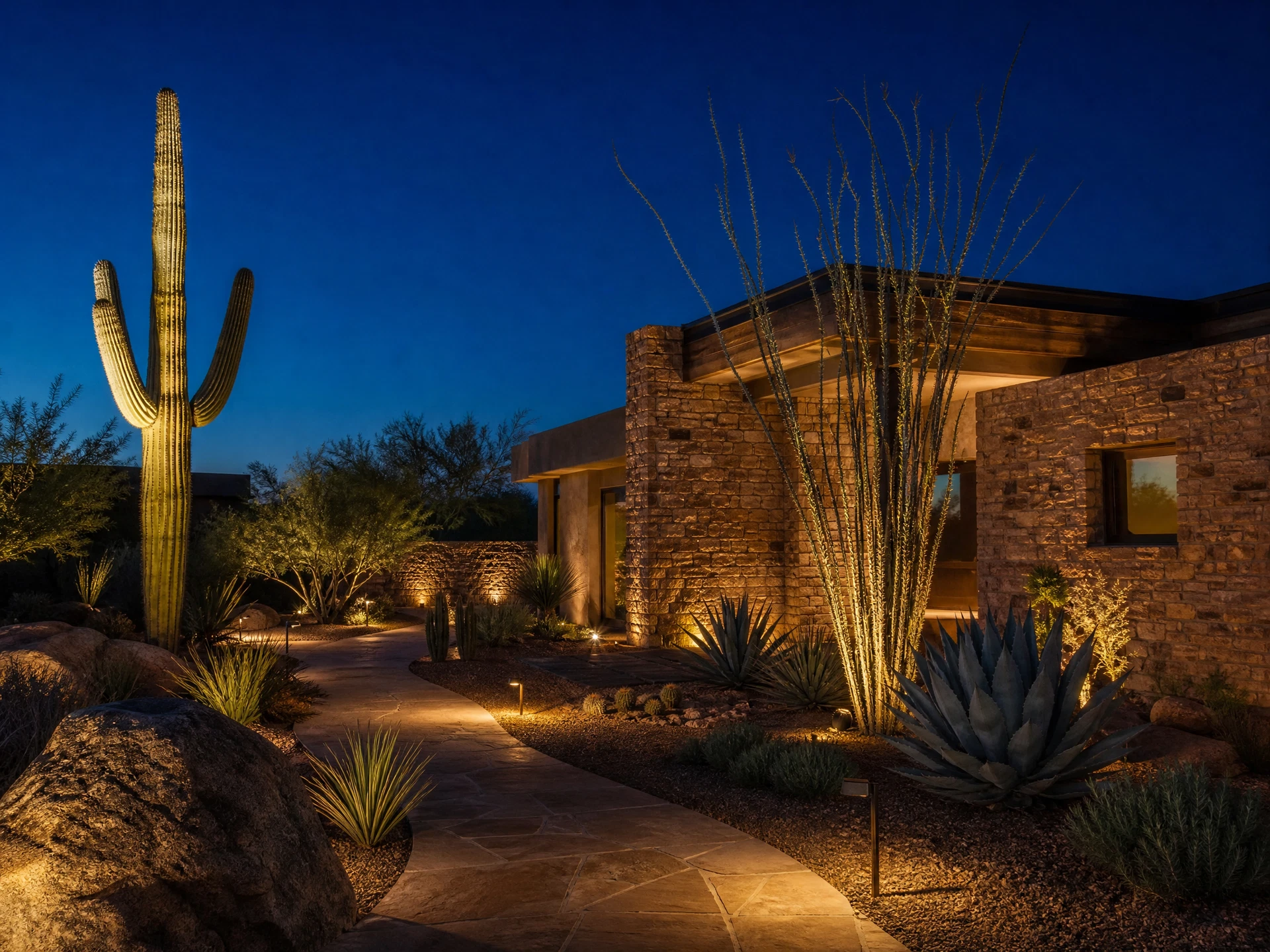
Understanding Transformer Sizing and the 80% Rule
A low-voltage transformer is the heart of a landscape lighting system, stepping down standard 120-volt household power to a safer 12-volt or 15-volt current suitable for outdoor fixtures. Proper sizing is critical; an undersized transformer will struggle to meet power demands, leading to dim or flickering lights, overheating, and premature failure. Conversely, an oversized transformer running a small load operates inefficiently and represents an unnecessary expense.[1][1]
The industry standard for sizing is the 80% rule, which dictates that a transformer should never be loaded to more than 80% of its total capacity. This provides a necessary safety buffer that reduces heat and strain on the equipment, significantly extending its lifespan. Furthermore, this 20% margin allows homeowners the flexibility to add additional fixtures in the future without needing to upgrade the entire transformer.[1][2][1][1]
Calculating Your Required Transformer Capacity
To determine the correct transformer size, begin by listing all planned fixtures and noting their power consumption. For modern LED fixtures, it is best to use the Volt-Amps (VA) rating if provided by the manufacturer, as it represents the true electrical load; if VA is unavailable, the standard wattage can be used. Add the VA or wattage of all fixtures together to find the total system load.[1][2][1][2]
Once the total load is calculated, apply the 80% rule by dividing the total by 0.80 to find the minimum required transformer capacity. Because transformers are sold in standard sizes (such as 100W, 150W, or 300W), always select the next standard size up from your calculated minimum. For example, a total load of 98 watts requires a minimum capacity of 122.5 watts, making a 150W transformer the appropriate choice.[1][2][1][1]
Choosing the Right Transformer for Phoenix Landscapes
When selecting a transformer for a Phoenix property, consider features that enhance durability and performance in the harsh desert environment. Professional-grade transformers often feature stainless steel enclosures, which offer superior resistance to corrosion and heat compared to powder-coated metal or plastic options. Additionally, features like digital timers and photocells provide convenient, automated control over the lighting schedule.[1][1][2]
For larger properties with extensive lighting runs, a multi-tap transformer is highly recommended. These units offer multiple voltage terminals (e.g., 12V, 13V, 14V, 15V), allowing installers to compensate for voltage drop over long distances. By connecting distant fixtures to a higher voltage tap, the power arrives at the required 12 volts, ensuring uniform brightness across the entire landscape.[1][2][1]